
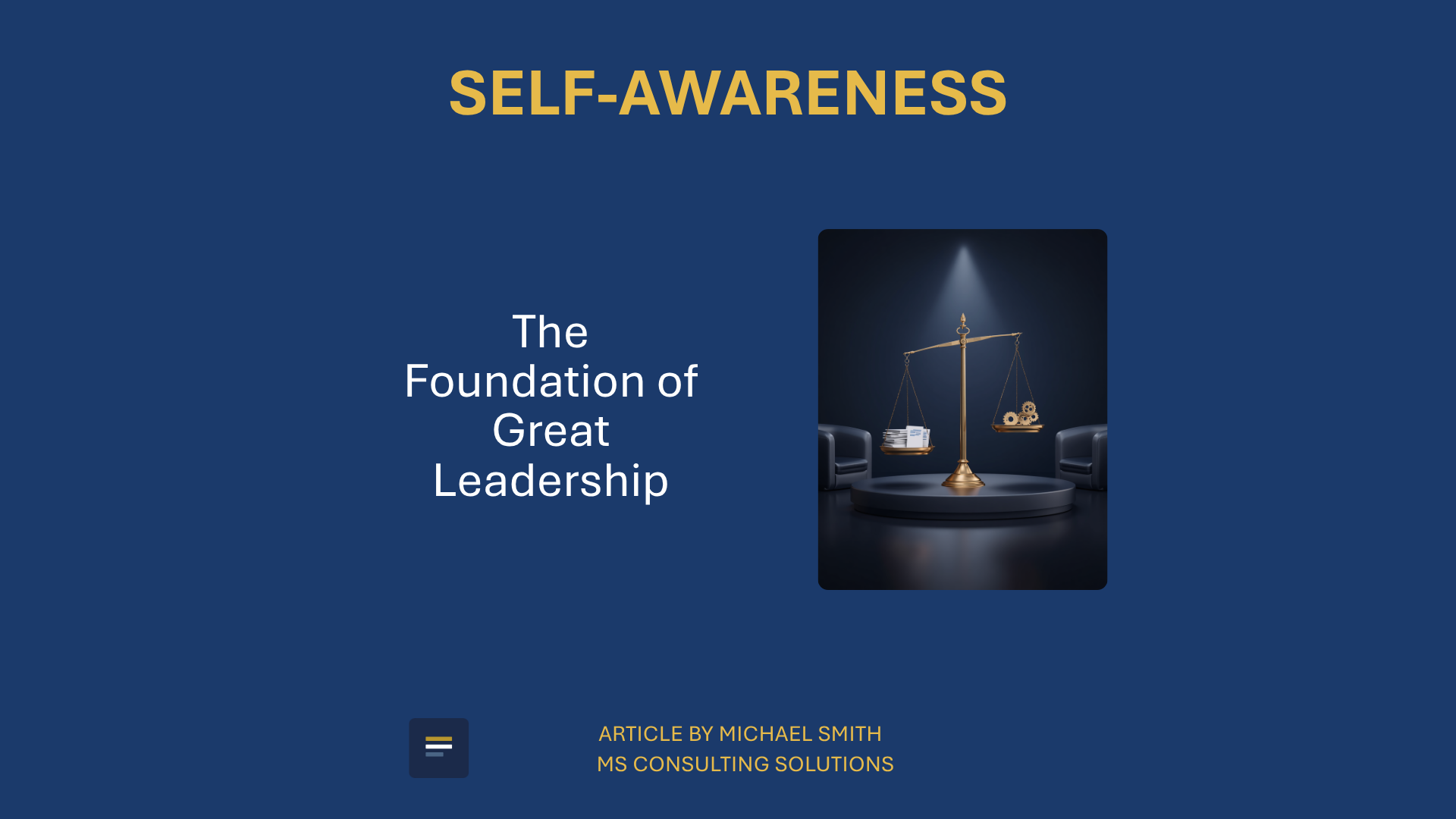
Twelve years ago, a Warrant Officer took me into his office and told me, without a flicker of tact, that my platoon didn’t fully trust me. Not because I wasn’t capable. Because I couldn’t take a report of bad news without my face broadcasting exactly how I felt about it, and my soldiers had learned to filter what they told me accordingly.
I was twenty six. I thought I was doing well. The feedback landed like a physical blow, because it was the first time in years that anyone had told me the truth instead of the version they thought I could handle.
That conversation has shaped how I lead more than any course I’ve ever sat. Not because it taught me a new skill. Because it showed me a gap I didn’t know existed, between how I saw myself and how the people I was responsible for actually experienced me.
I think about that gap constantly now, twenty years into a career that’s taken me from the Army into BAE Systems, Network Rail and BT Openreach, and now into building MS Consulting Solutions. Every capability problem I’ve written about in this series eventually traces back to it. You can fix decision rights. You can fix development pipelines. You can fix institutional memory. But if the person sitting at the top of your leadership structure can’t see themselves clearly, none of it holds for long.
The Confidence Trap
Most organisations promote for confidence, not self-awareness. It’s an easy mistake to make, because from across a boardroom table the two look identical. A confident leader speaks decisively, owns the room, and rarely looks unsure. A self-aware leader does some of that too, but also knows precisely where their judgement runs out, and says so.
Interview panels reward the first trait constantly and the second almost never. Nobody asks “tell me about a time you got your own leadership badly wrong, and how you found out.” They ask about achievements, about influence, about times you turned a situation around. All useful questions. None of them test whether a candidate has any real insight into their own blind spots.
Organisational psychologists have spent decades studying the gap between how self-aware people believe themselves to be and how self-aware they actually are, and the finding holds up consistently: the overwhelming majority of people rate themselves as self-aware, while only a small fraction, by any honest external measure, genuinely are.
This is what makes self-awareness so dangerous to overlook in a leadership pipeline. It doesn’t show up on a competency framework next to strategic thinking or stakeholder management. Nobody puts it on a job description. But it’s the one trait that determines whether every other leadership skill you’ve hired for gets used well, or gets weaponised.
Two Kinds of Self-Awareness and Most Leaders Only Have One
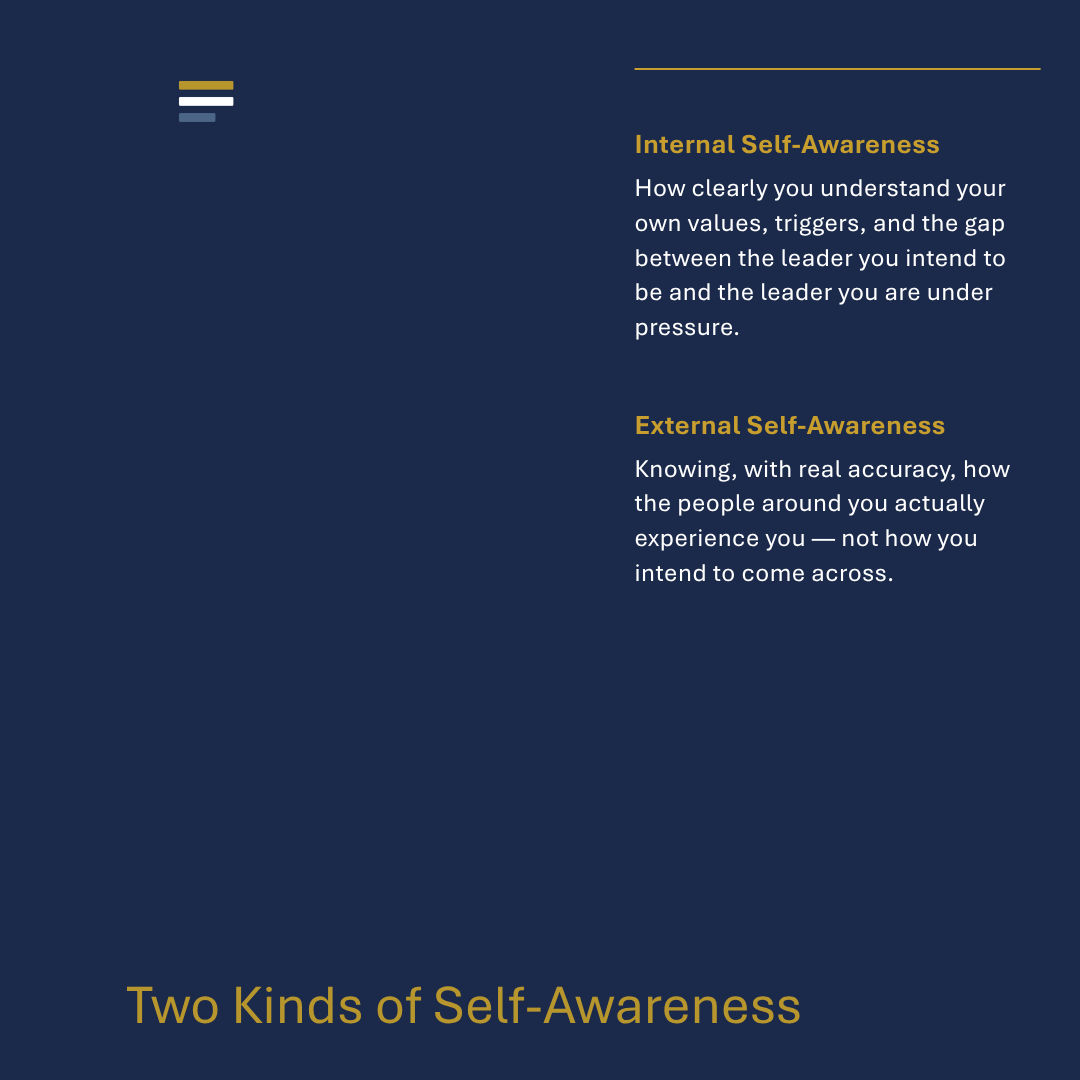
I split self-awareness into two distinct things, because treating it as a single trait is where most development programmes go wrong.
The first is internal self-awareness. This is how clearly you understand your own values, your triggers, the situations that pull the best and the worst out of you, and the gap between the leader you intend to be and the leader you actually are under pressure. Most senior leaders have some version of this. Twenty years in demanding environments forces a degree of internal reflection, whether you go looking for it or not.
The second is external self-awareness, and this is where nearly everyone falls down. External self-awareness is knowing, with reasonable accuracy, how the people around you actually experience you. Not how you intend to come across. How you land. The two are rarely the same thing, and the gap between them widens the more senior you become, because seniority insulates you from honest feedback exactly when you need it most.
A Story from the Programme Floor
I worked alongside a programme director years ago who was, by every technical measure, excellent. Sharp planning instincts, deep domain knowledge, genuinely good with clients under pressure. He was also, by his own account, completely approachable. Open door. Easy to talk to. He said it in nearly every one to one I sat in on.
His team didn’t experience him that way. They experienced someone who, when handed bad news, would go quiet for a beat too long before responding, and then ask three rapid follow up questions in a tone that read as scepticism rather than curiosity. Reasonable people, faced with that reaction twice, learn to hold problems a little longer before raising them. Hold them long enough, and small issues become expensive ones by the time they surface.
Nobody told him, because telling him felt career limiting. The information gap wasn’t a communication problem, even though it looked exactly like one from the outside. It was a self-awareness problem wearing a communication problem’s clothes, and it cost that programme real money before anyone traced it back to its actual source.
Where the Blind Spot Actually Costs You
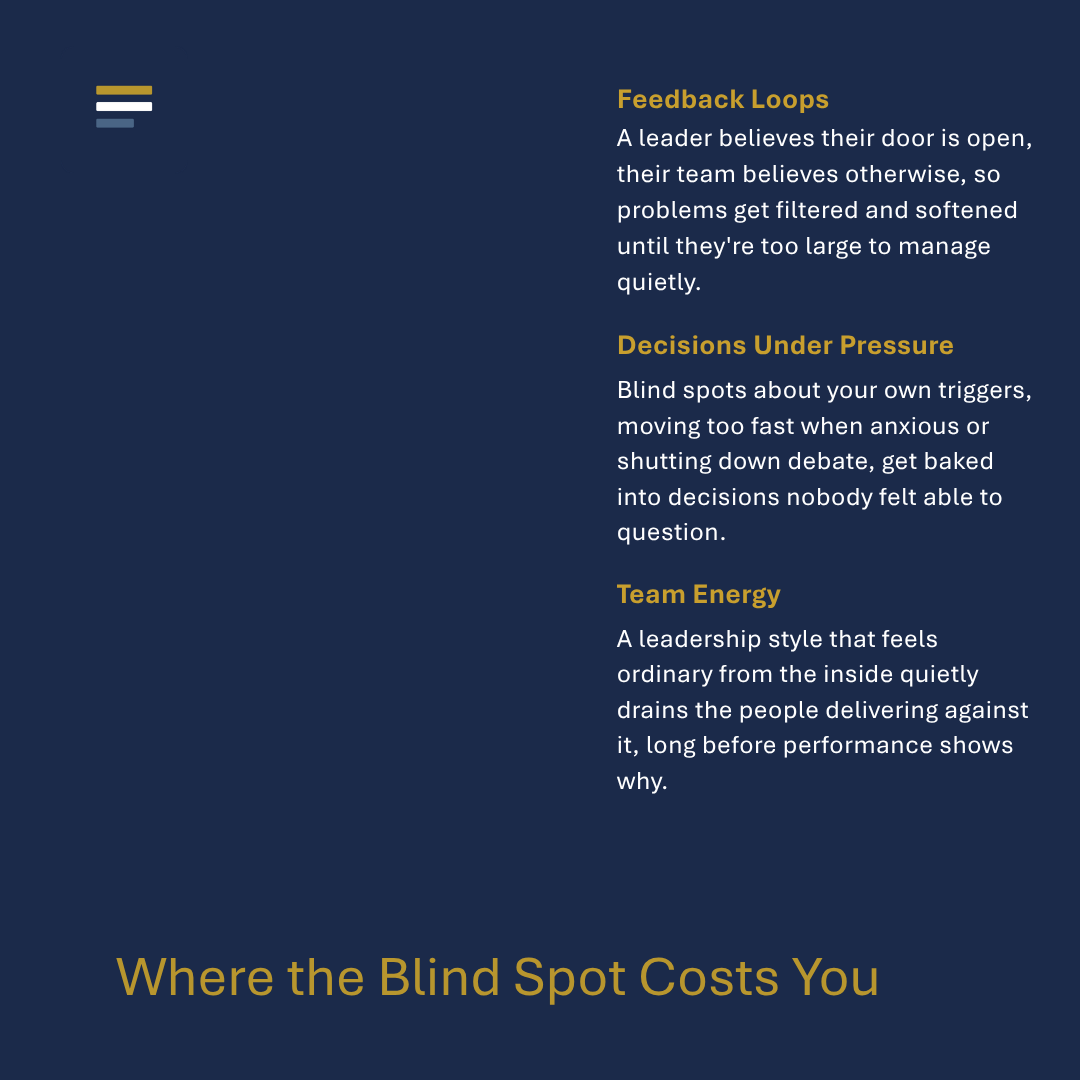
The gap between how leaders see themselves and how they’re experienced doesn’t stay contained to one uncomfortable conversation. It compounds in three places I see over and over.
It shows up in feedback loops, where a leader believes their door is open and their team believes otherwise, so problems get filtered, softened, or simply not raised until they’re too large to manage quietly. It shows up in decision making under pressure, where a leader’s blind spots about their own triggers get baked into decisions nobody in the room felt able to question. And it shows up in team energy, where a leadership style that feels perfectly ordinary from the inside is quietly draining the people expected to deliver against it, long before anyone can name why performance has started to slip.
Why I Build Every Engagement Around This
This is the reason I use Insights Discovery as a foundation with almost every leadership team I work with not as a novelty exercise, but because it gives people an external, structured mirror they can’t easily argue with. It’s much harder to dismiss feedback about how your energy lands on a team when it’s grounded in a consistent, well researched framework rather than one colleague’s opinion on a difficult day.
The tool doesn’t do the work itself. It simply makes the blind spot visible enough that avoiding it stops being a realistic option, for the leader or for the team around them.
It also does something else organisations rarely account for: it shows leaders that self-awareness isn’t only an individual problem. Teams develop their own collective blind spots a shared style that feels completely normal from inside it and looks strange or even hostile from outside it.
Building Self-Awareness Deliberately
Here’s the uncomfortable truth: experience alone doesn’t build self-awareness. I’ve met leaders with thirty years behind them who understand themselves worse than a twenty eight year old who’s had the discipline to seek out honest feedback consistently. Years in a role teach you your job. They don’t automatically teach you yourself.
Building it deliberately means creating structures that make honest feedback safe and routine, rather than rare and risky. It means using tools like Insights Discovery not as a one off away day exercise but as a shared language a team returns to regularly, so noticing a blind spot becomes normal rather than confrontational. It means leaders actively seeking out the person in the room most likely to disagree with them, rather than the person most likely to confirm what they already believe.
Where to Start
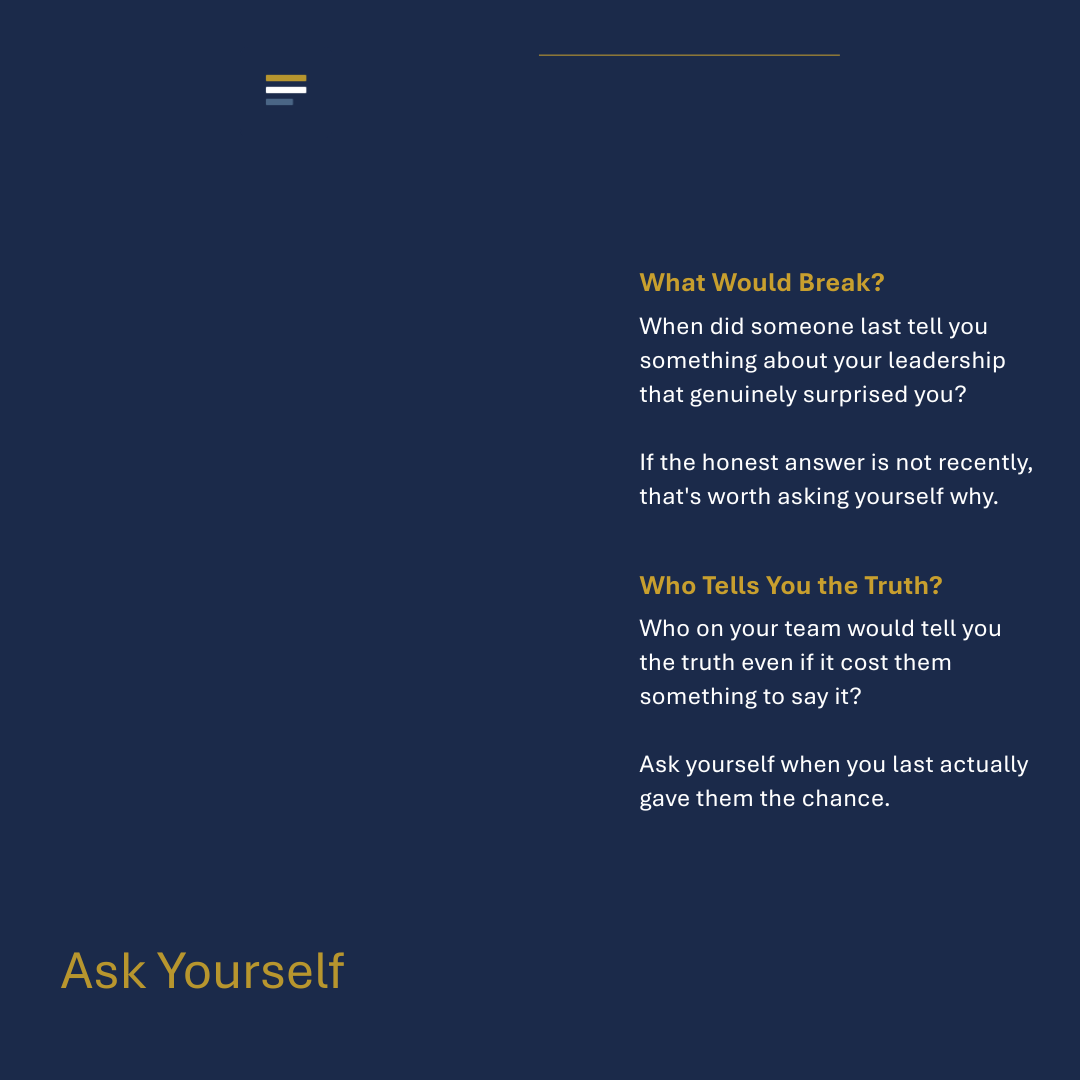
Ask yourself three questions this week. When did someone last tell you something about your own leadership that genuinely surprised you and if the honest answer is “not recently”, ask yourself why not. Who on your team would tell you the truth even if it cost them something to say it, and when did you last actually ask them directly. And what would the people two levels below you say about how it feels to raise a problem with you, compared with what you assume they’d say.
If those questions are uncomfortable to sit with, that’s the gap making itself known. Good. You can’t close a gap you won’t look at directly.
The Bottom Line
Every pillar in the Capability Advantage purpose, strategy, teams, culture, execution and learning runs through leadership eventually. And leadership runs through self-awareness first. You can build the best decision architecture in the world, the cleanest development pipeline, the most resilient institutional memory, and still watch it come apart if the people leading it can’t see the gap between the leader they believe they are and the leader their team is actually experiencing.
Self-awareness isn’t a soft skill you get around to once the harder strategic work is done. It’s the foundation the rest of it stands on. Skip it, and you’re not building leadership capability. You’re building leadership confidence, and hoping nobody notices the difference until it’s too late to matter.
“The most expensive gap in any organisation isn’t the one between strategy and execution. It’s the one between how a leader sees themselves and how everyone else already does.”
Michael Smith is the Founder of MS Consulting Solutions and a leadership development specialist. He works with organisations to build high-performing teams, close the capability gaps that quietly limit performance, and develop leaders at every level — starting with self-awareness. Get in touch to discuss how we can help your organisation.