
Every time a business misses target, a project stalls, or a team underperforms, the same word gets reached for first: leadership.
“We need better leaders.” “Send them on a course.” “Get a coach in.”
I’ve built a career on leadership development, so I’ll say this plainly: that instinct is usually wrong.
Not because leadership doesn’t matter. It does, enormously. But because most organisations diagnose the wrong problem, treat the wrong symptom, and then wonder why nothing changes eighteen months later.
The Diagnosis Everyone Gets Wrong
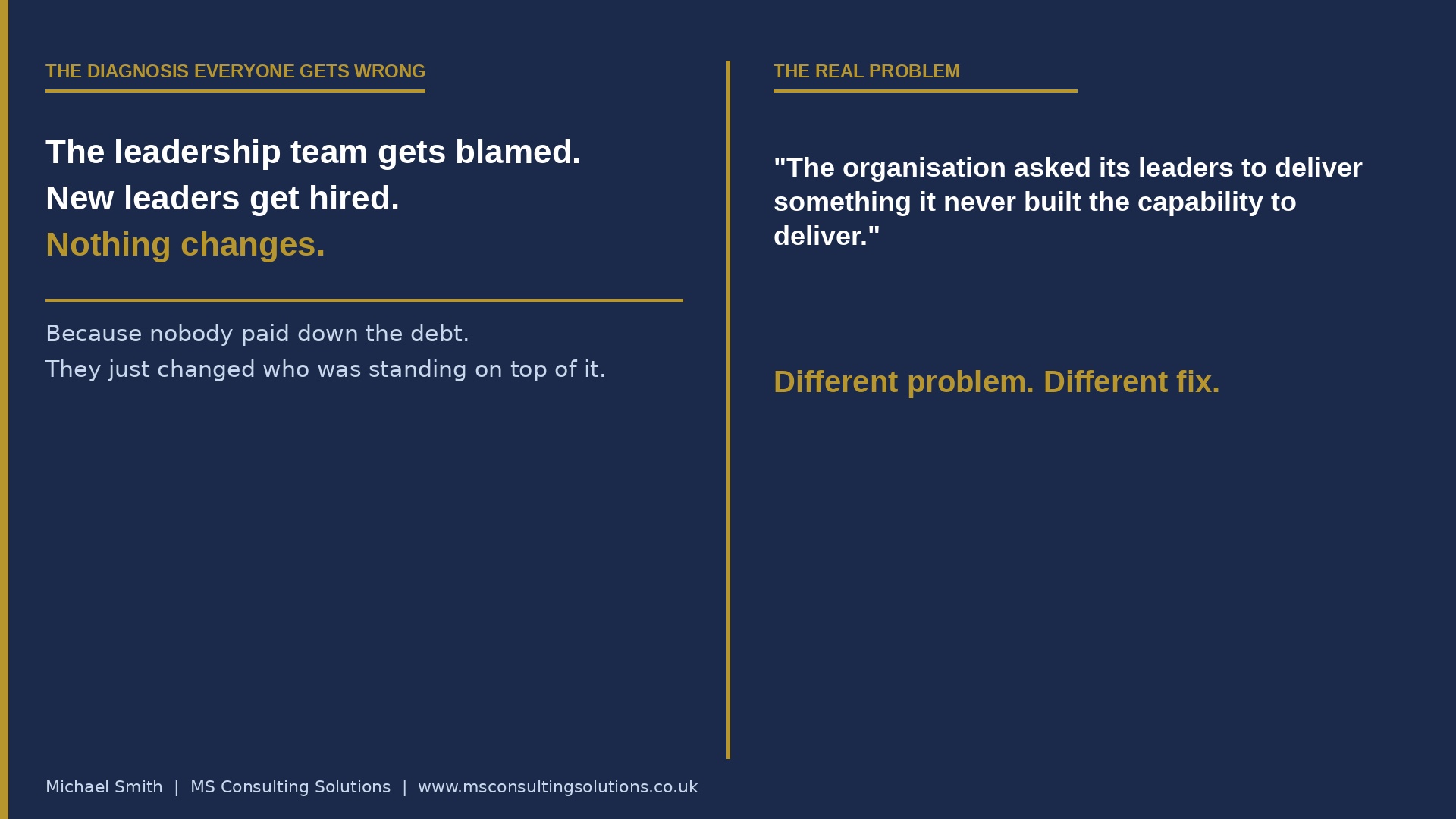
Picture the scene. Results are down. The board wants answers. Someone in the room says the leadership team “isn’t strong enough”, and everyone nods because it’s easier than the alternative.
The alternative is harder to say out loud: the organisation asked its leaders to deliver something it never built the capability to deliver.
Different problem. Different fix.
“You can replace every leader in a building and the building will still be broken, if the building was the problem.”
What I Saw in the Army — and What I’ve Seen Since
I spent years in the British Army before I spent years in consulting, and the thing that took me longest to unlearn was this: in the Army, capability is built deliberately, long before it’s needed. Training isn’t a reaction to a performance problem. It’s the system.
Leadership sits inside that system. It doesn’t replace it.
Then I moved into large infrastructure delivery — Openreach, major programmes, thousands of people, enormous complexity — and I watched good leaders get chewed up by organisations that had never built the systems around them.
Put a genuinely excellent leader into a capability vacuum and watch what happens. They burn out, or they leave, or they become the single point of failure the organisation quietly depends on — which is the most dangerous outcome of all.
That’s not a leadership problem. That’s an organisation that outsourced its capability gap to one person’s willpower.
Leadership vs Capability: The Distinction That Matters
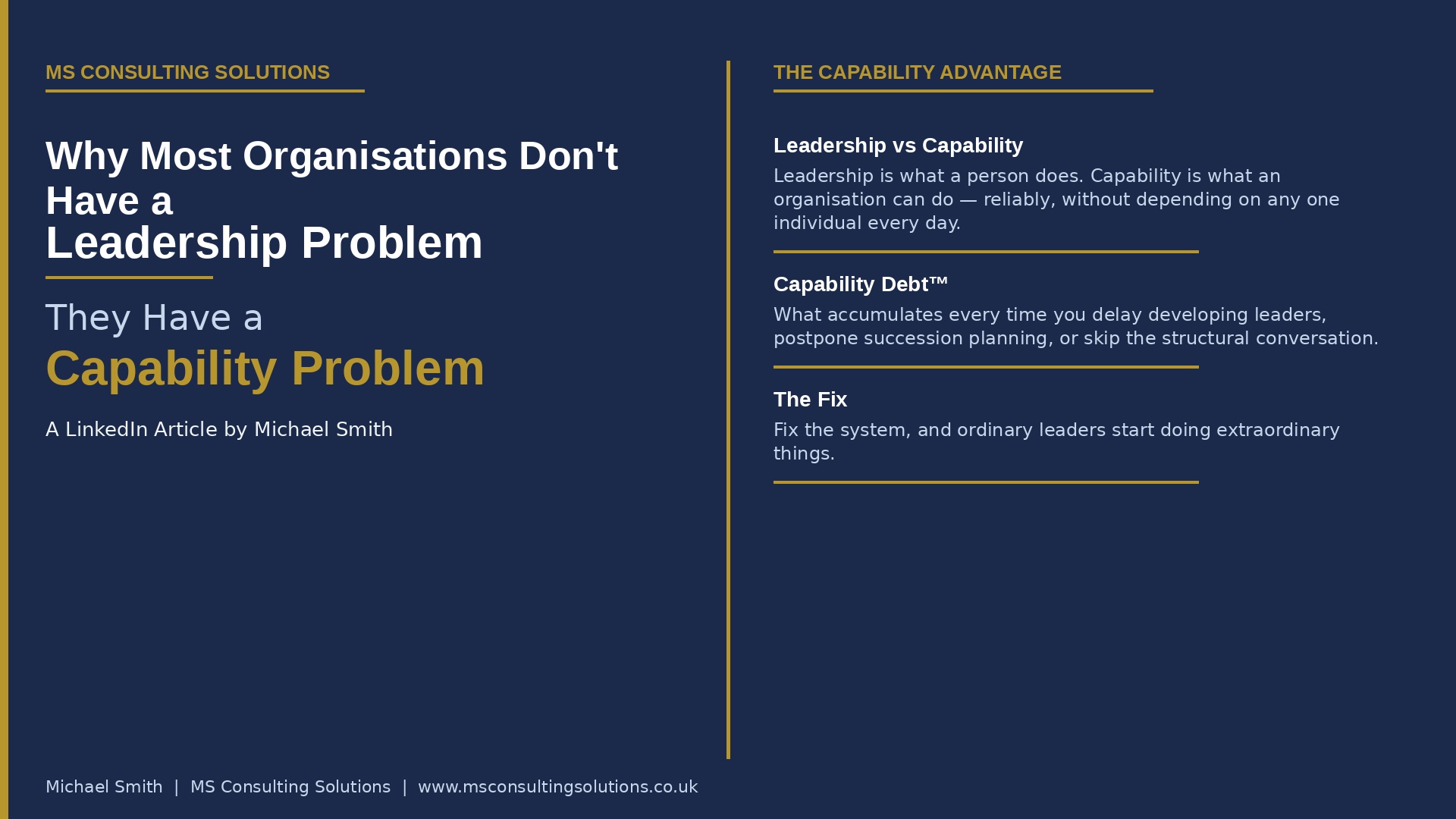
Leadership is what a person does. Capability is what an organisation can do — reliably, repeatably, without depending on any one individual being exceptional every single day.
Most businesses have never separated the two. They measure engagement. They measure performance. Almost nobody measures capability — the actual, honest gap between what the strategy demands and what the organisation can currently deliver.
That gap has a name. I call it Capability Debt.
Introducing Capability Debt™
You’ll know technical debt if you’ve worked anywhere near software: the shortcuts taken to hit a deadline that quietly cost you double later, in a system nobody fully understands anymore.
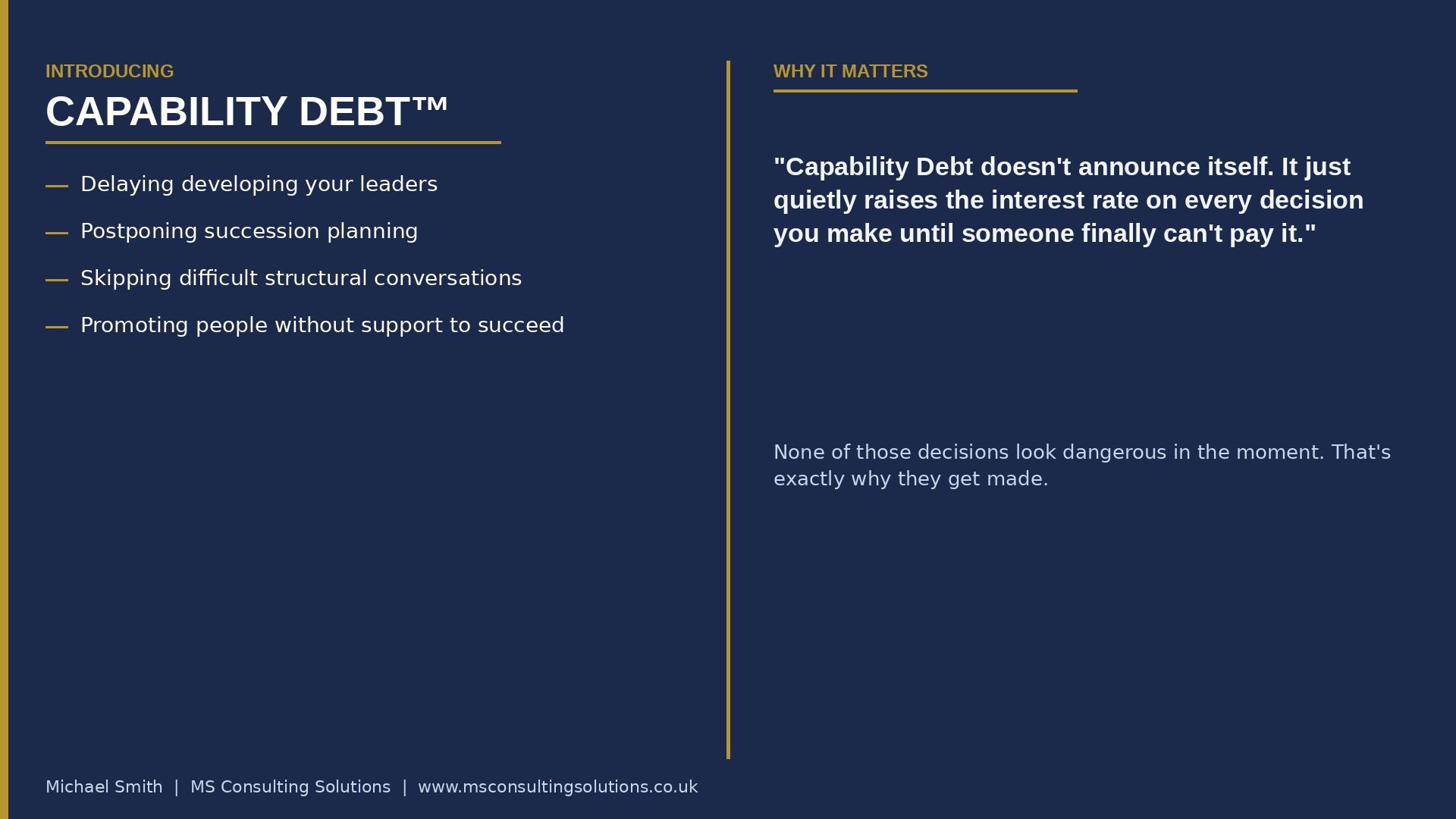
Capability Debt works the same way. It’s what accumulates every time an organisation delays developing its leaders, postpones succession planning, skips the difficult structural conversation, or promotes someone without building the support around them.
None of those decisions look dangerous in the moment. That’s exactly why they get made.
The debt doesn’t show up on a balance sheet. It shows up eighteen months later as missed delivery, exhausted leaders, and a board asking why ‘leadership’ isn’t working — when leadership was never given a system to work inside.
“Capability Debt doesn’t announce itself. It just quietly raises the interest rate on every decision you make until someone finally can’t pay it.”
The Three Places Capability Debt Hides
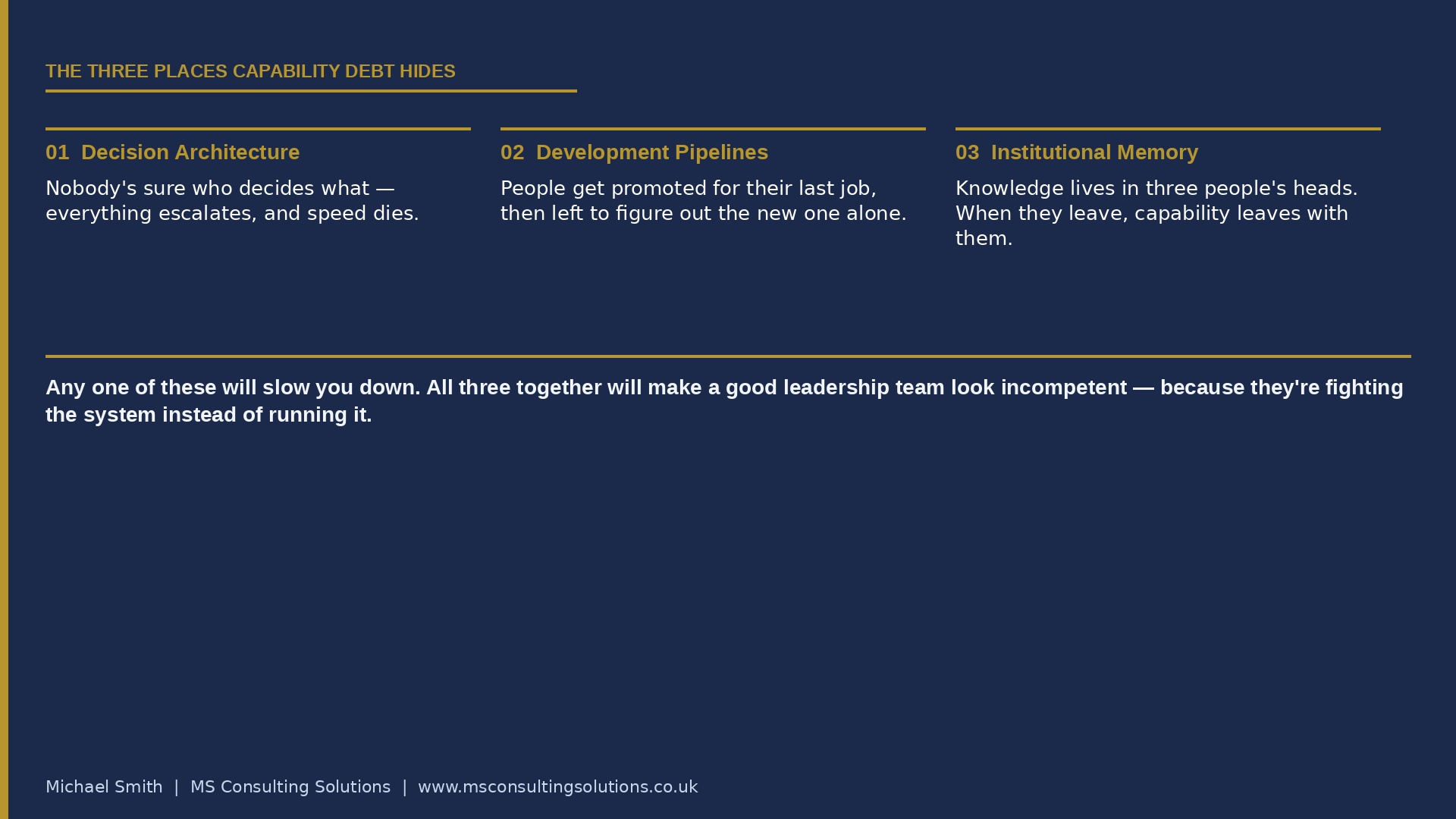
In every organisation I’ve worked with, it collects in the same three places.
- Decision architecture — nobody’s quite sure who’s allowed to decide what, so everything gets escalated, and speed dies.
- Development pipelines — people get promoted for being good at their last job, then left to work out the new one alone.
- Institutional memory — knowledge lives in three people’s heads instead of the system, so when they leave, capability leaves with them.
Any one of these will slow you down. All three, together, will make a perfectly capable leadership team look incompetent — because they’re fighting the system instead of running it.
What This Costs You
Organisations carrying heavy Capability Debt tend to look the same from the outside: strategy days that produce beautiful documents nobody executes, transformation programmes that stall at the same point every time, and a leadership team that’s visibly exhausted but can’t quite explain why.
The leadership team gets blamed. New leaders get hired. The debt doesn’t move, because nobody paid it down — they just changed who was standing on top of it.
The Capability Advantage
This is the thinking behind what I call the Capability Advantage — a different way of looking at organisational performance that treats capability as seriously as strategy, and leadership as one part of a broader system, not the solution to every problem the system creates.
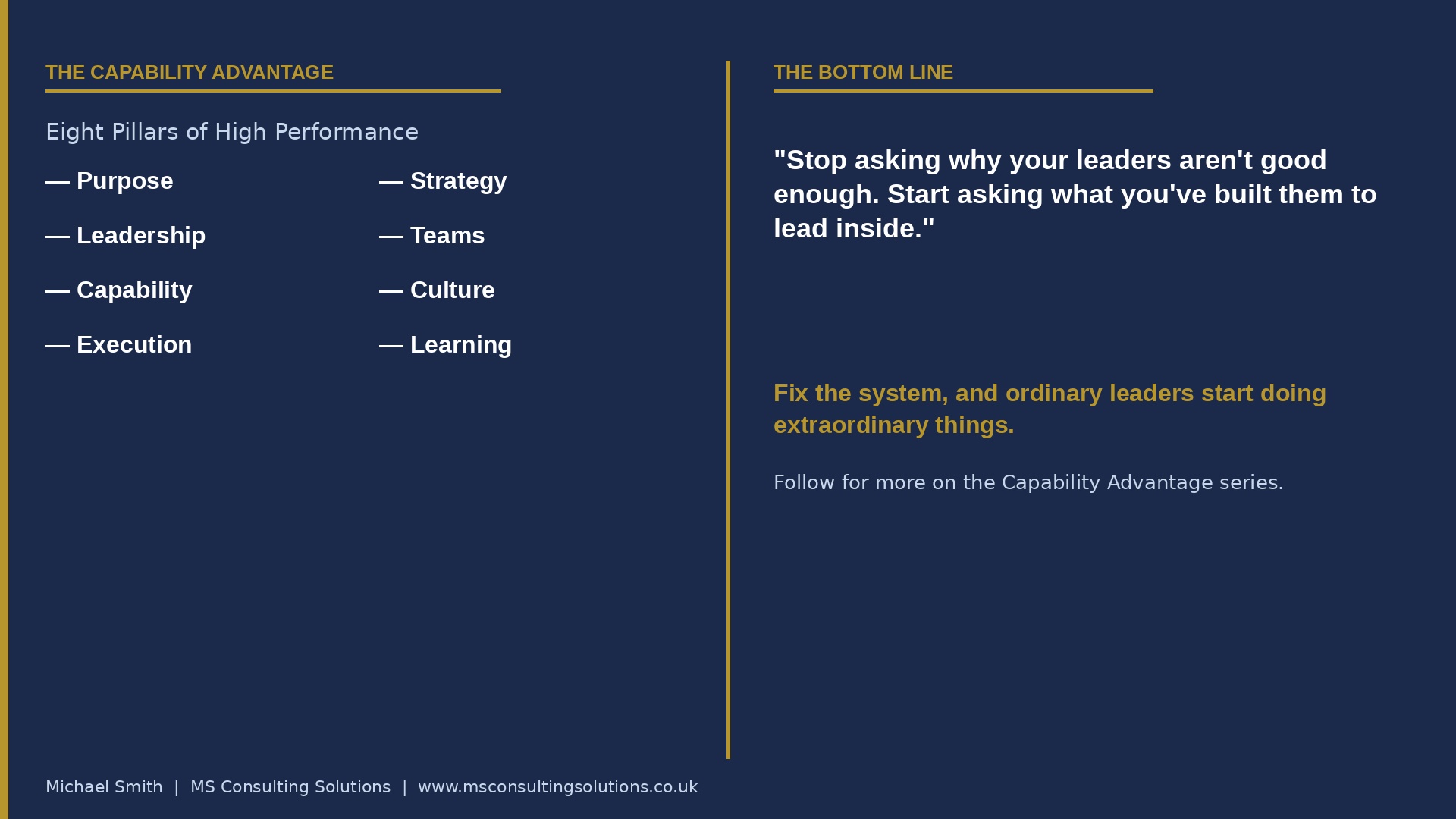
It rests on eight pillars: purpose, strategy, leadership, teams, capability, culture, execution, and learning. Get leadership right in isolation and you’ve fixed one pillar. Get the whole system working and you’ve built something that performs without depending on any single person being exceptional every day.
Where to Start
You don’t fix Capability Debt with a single workshop, any more than you fix technical debt with a single sprint. But you can start seeing it, which is most of the battle.
Ask yourself three questions this week: if your best leader left tomorrow, what would actually break? How many decisions in your organisation take longer than they should because nobody’s sure who owns them? And where does knowledge about how things really work live — in the system, or in one person’s head?
If those questions are uncomfortable, you’ve found the debt. Good. You can’t pay down what you won’t name.
The Bottom Line
Your leaders are probably not the problem.
The system they’re operating inside — built by years of shortcuts, quiet delays, and decisions nobody thought were a big deal at the time — almost certainly is.
Fix the system, and ordinary leaders start doing extraordinary things. Ignore it, and your best leaders will keep leaving, one at a time, wondering why the organisation never quite backed them.
“Stop asking why your leaders aren’t good enough. Start asking what you’ve built them to lead inside.”
Michael Smith is the Founder of MS Consulting Solutions and a leadership development specialist. He works with organisations to build high-performing teams, close the capability gaps that quietly limit performance, and develop leaders at every level. Get in touch to discuss how we can help your organisation.